
The noticeable effect of suicide’s depiction in entertainment is nothing new.
Two examples – one negative, one positive, go back to the 1700s. Goethe’s popular novel The Sorrows of Young Werther – about a character who takes his own life – led to many recorded instances of “suicide contagion” or “copycat suicide,” also now known as “The Werther Effect,” with many readers emulating the death, dressing up in similar clothing and using the same type of firearm.
In contrast, “The Papageno Effect” – named after a character in Mozart’s The Magic Flute, in which the character Papageno plans to take his own life, but is helped by his friends, who remind him of healthy ways to manage his emotional pain – was shown to have a positive effect.*
Entertainment Guidance Hub

The way you handle the topic of suicide in fictional narratives and storytelling makes a difference. Here, you’ll find evidence-based guidance on how to tell stories safely, while being true to the artistic voice of your project.
Just as scientific research provides us clear insights into safe reporting on suicide – how journalists can help avoid the risk of suicide contagion, and even have a positive effect – research also tells us how to safely portray the topic of suicide in fictional narratives and personal storytelling.
Tell Stories That Inform, Inspire, and Support
Are you an entertainment industry professional or creative artist with a project in active development? In addition to the in-depth guidance provided on this site, AFSP is able to consult on select projects. Please reach out and include information about your project through the form below, and we’ll reach back out as soon as we can.
What you include in a story isn’t going to make a random person want to take their own life. But the way you tell stories involving suicide can potentially be dangerous for viewers who already happen to be in a state of crisis. Unfortunately, that’s likely a significant number of people at any given moment.
Happily, the way you handle the topic can:
- encourage help-seeking
- provide examples of how people might safely have realistic, human conversations about mental health
- increase our culture’s understanding of this leading cause of death, and mental health in general
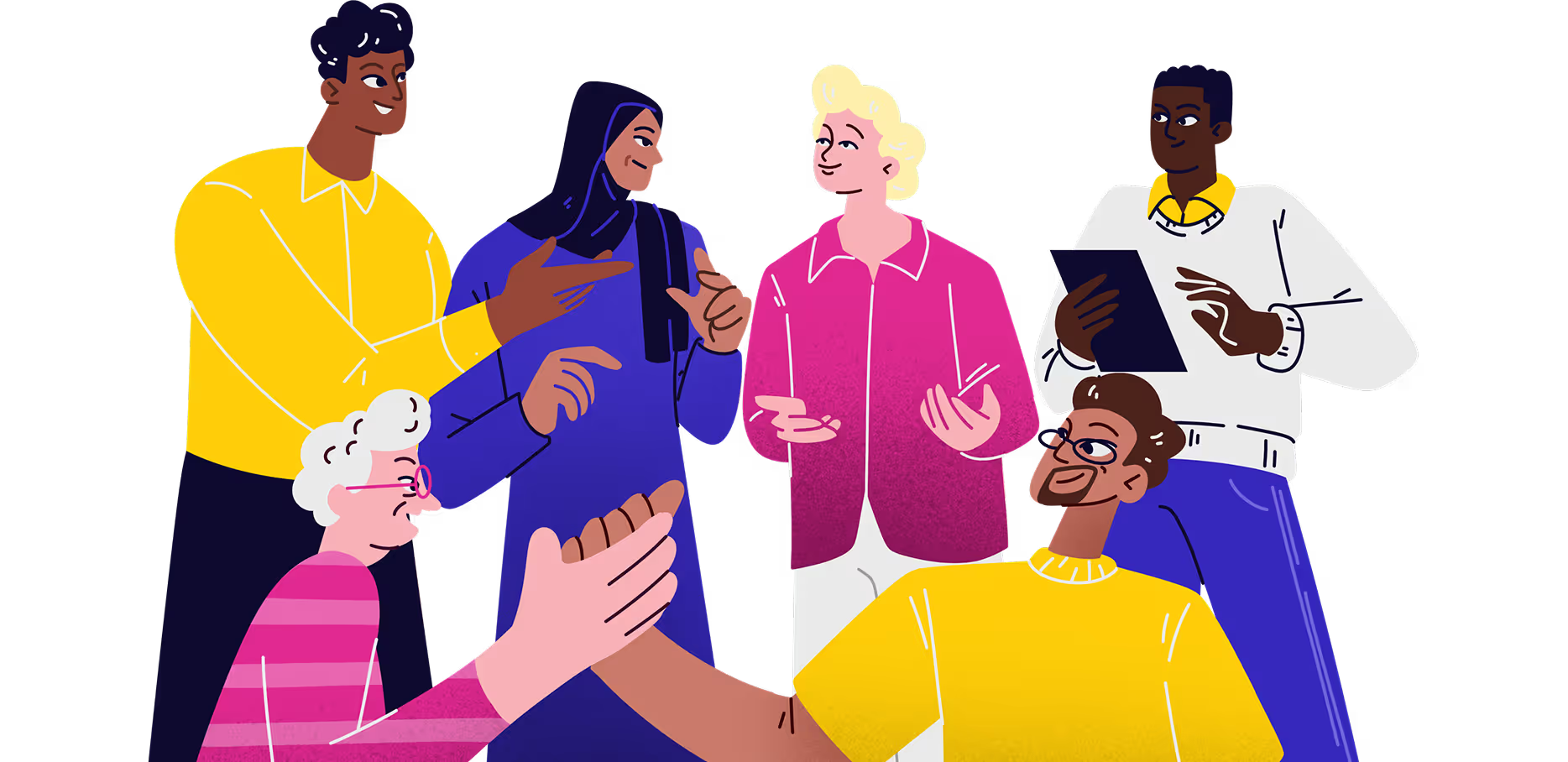

The American Foundation for Suicide Prevention wants creative artists – whether you’re a writer, director, producer, actor, storyteller, musician, poet, podcast host, visual artist, or someone else – to feel confident in your ability to safely and responsibly tell whatever story you want to tell, in whatever tone or style you wish to tell it.
Here are 10 things to keep in mind when telling stories involving suicide and mental health:

Avoid visually showing a suicide attempt (or death) onscreen, or including method details
If there’s one thing to remember, it’s this: don’t show a suicide or suicide attempt onscreen. A common (mistaken) assumption from creators is that if they make a suicide attempt seem unpleasant, it will discourage people from doing it in real life. Unfortunately, research indicates that showing a suicidal act on screen has the opposite effect and can be highly dangerous for viewers who are already at risk. This also includes showing a character in an intense, painful lead-up to an attempt, or displaying the visual aftermath of a suicide.
The reason this is so important is that viewers should not be put in the position of vicariously experiencing the same degree of intense pain that the character is experiencing. Use your creative powers to imagine how a viewer in distress might react, and what message they may mistakenly believe the story is sending them.
Subtle creative choices can make a huge difference. For example, if some element involving the suicidal act is absolutely essential to the plot – in a way that you can’t avoid a brief visual moment – you can get creative in making it safer. Consider focusing on another character’s reaction, instead. Maybe it isn’t a close-up. If you hear the sound of something off-screen, make sure the sound isn’t terribly loud or sudden. If a character survives an attempt, you might show bandages around their wrist if you feel it’s completely necessary…but not the stitches, which some viewers might have an intense, visceral reaction to. These are just a few specific examples of what to consider.
…or heavily focusing on the method used in dialogue
You should also avoid putting a sustained, lengthy emphasis on specific details related to the lethal means used in a suicide attempt in dialogue. You don’t want to give people ideas of how they might take their own life – and long discussions of the method used in an attempt can be triggering for some viewers. If the method used is important to the plot – if it’s a mystery, for instance –only provide as much detail as necessary.
Think of it like this: if you’re telling a story that is deeply, thematically about suicide, the act itself isn’t where the nuance is. One of the most celebrated films involving suicide is the Oscar-winning Ordinary People, which featured a teenage character (Timothy Hutton) recovering from his own suicide attempt following the death of his brother. Do you remember the attempt scene from that film? You don’t, because that moment took place before the movie begins – and you probably didn’t even notice. Good storytelling is all about ‘show, don’t tell’ – but you have a choice as to what you’re showing. That film showed the main character deeply focusing on his inner pain in therapy, and how it impacted his life as a whole: both internally and how it affects his relationship with other characters.
Dialogue is a great place to get into the nuance of feeling and relationships. Just avoid dwelling on the physical details of a suicide attempt or death. And if the story isn’t about suicide on a deeply thematic level, but happens to be included as a story element – in a mystery, horror, or other genre – that’s fair, too! Just keep the discussion of lethal means to its bare minimum of what’s necessary to the plot.
Don’t oversimplify the “Why”
It’s really important not to oversimplify what leads someone to suicide. One interesting thing we know from research is that no one takes their life for a single reason. In other words, it’s very natural to look for a simple “reason” someone died by suicide. We might suspect they took their own life because of a divorce, or a job loss, bullying or money problems. But generally, when someone takes their own life, it’s due to a perfect storm of multiple risk factors, which may include a “life stressor” like the above, but could also include others, such as a mental health condition, family history of suicide, childhood abuse, or chronic physical pain. Showing that a suicide death isn’t merely the result of one simple reason not only moves the audience’s understanding forward – it’s also a creative opportunity to provide greater dimension to your story, and your characters.
Case in point: you can use that link above as a handy cheat sheet to look up the risk factors associated with suicide, as well as protective factors and warning signs that viewers (or other characters) might notice preceding a suicide attempt or death that takes place in your story.
Avoid romanticizing emotional pain or glorifying a suicide death
We all know the archetype of the “tortured artist,” or the character whose pained psyche, untreated by a mental health professional, magically drives them to creative or professional success. The reality, however, is that someone experiencing clinical depression, serious anxiety or some other psychological issue is often in too much pain to be very productive. Both therapy and medication have been shown to help people, and unintentionally romanticizing a mental illness can dissuade people from getting help.
Research also shows there is a danger in overly glorifying the memorialization of a suicide death. Someone in a suicidal state – wherein their thinking is affected – may view their death as a way of “sending a message” or evoking an emotional response in others. So when a character dies by suicide and it’s followed by an over-the-top funeral scene filled with long, emotional tributes or video flashbacks of their life – or big, physical testaments to the death, like an elaborate shrine, lots of candles and photos, etc. – it can make suicide seem like an effective means to get peoples’ attention, or exact some form of revenge. Most people don’t leave a note, by the way – and while that’s an enticing dramatic device, featuring the contents of a long note via video, voiceover or otherwise can send that same dangerous message.
It’s all a matter of degree. Someone’s suicide death will of course have an effect on people, as is the case with any death. But being aware of the considerations above will help you avoid making suicide seem like an enticing option for anyone watching. The Big Chill, another classic film about the effects of a suicide death – and which, like Ordinary People, wisely avoids showing the death itself – has a nicely done, understated funeral scene that avoids this issue, and is followed by a realistic examination of the effect the death has had on his group of friends.
Speaking of suicide loss, no one grieves the same way, even among tight-knit families and communities. “Suicide loss survivors” experience different emotions, and heal on different timelines. But support is available. You can familiarize yourself with some of the elements involved by watching some of the International Survivors of Suicide Loss Day documentaries, watching AFSP’s “Living with Suicide Loss” videos, and reading articles involving loss on AFSP’s Real Stories blog.
Encourage help-seeking
While it should be easier for all of us to access help – which is why mental health parity is one of the key policy priorities supported by AFSP’s network of Volunteer Advocates – help is always available for people who need it, such as from the National Suicide Prevention Lifeline (988) or the Crisis Text Line, both free and available 24/7. The reality, too, is that the majority of people in this country recognize mental health as being just as real as physical health. Many of us, whether we realize it or not, are likely surrounded by people who will not judge us for what we are experiencing or for asking for help. So while a character in your story may not realize it themselves, it’s important to at least give your audience an indication that help exists.
Encouraging help-seeking can be as simple as including a single line of dialogue from a healthy character saying they’re off to their weekly shrink appointment, or showing a therapist who behaves caringly and professionally. (Uzo Aduba on HBO’s In Treatment reboot is a great example, particularly in that it shows a mental health professional of color, with clients from diverse backgrounds.) Mare of Easttown and The Bear both featured positive and authentic instances of help being available for those who’ve lost someone to suicide. Can you include a scene with a terrible therapist? Of course! But try to balance it out with one who isn’t, or with a line from another character who says they like their own therapist.
The same holds true for depictions of psychiatric facilities. There’s the dangerous, outdated cliché of mental health institutions being nightmarish prisons in which patients are prisoners, surrounded by uncaring “guards” forcing them to take pills to keep them docile, a la One Flew Over the Cuckoo’s Nest. Try to give a realistic, accurate idea of what a hospital stay might be in today’s world. Is every scene you see of a non-psychiatric hospital terrifying or negative? No. The same should hold true for mental health facilities.
Overly negative portrayals of mental health facilities – especially if those are the only depictions an audience sees of them – not only discourage people from getting treatment; they also “other” those with mental health conditions. (While we’re on the subject, avoid the false link between mental illness and violence—the reality is that people with mental health conditions are statistically more likely to be the victims of violence, than perpetrators of violence.)
It can be hard to find the right mental health professional or the right medication – just as it is can be regarding physical care – but research shows that most people managing a mental health condition are helped by therapy or medication, or a combination of the two. Chris Gethard’s one-man show-turned HBO special Career Suicide does a glorious job of realistically (and hilariously) telling the story of that sort of obstacle, avoiding the myth that medication will dampen someone’s personality or creativity, and ultimately encouraging those who need support to get it.
Speaking of which…
Comedy is okay! (and even encouraged)
Most of our lives include both comedy and tragedy, the silly and the serious. There is indeed humor to be found in stories involving mental health challenges and even suicide. Recognizing those bits of lightness (even if it’s dark humor) can even be encouraging for viewers. The important thing is that you don’t punch down and make someone’s pain or mental health condition the butt of the joke.
One good example of navigating that nuance is Lieutenant Tilly on Star Trek: Discovery. Though not explicitly stated, many have interpreted her character as having Autism; and while the writers find comedy in the nooks and crannies of her character, just as they would with any character – they also make sure to show how capable and human she is. The sitcom Friends featured a running throughline involving Phoebe’s incredibly traumatic childhood – including the fact that her mother had died by suicide. But rather than mean-spiritedly using that as a punching-bag, the underlying source of those jokes was generally how innocently badass Phoebe was in taking her difficult experiences in stride, as though they were common.
Other great examples include BoJack Horseman, You’re the Worst, and The Great Depresh, comedian Gary Gulman’s mixture of standup and documentary that recounted his experience with suicidal thoughts, hospitalization, and ECT, blending painful realities with honest encouragement. The Australian comedy Please Like Me, whose protagonist (played by series creator Josh Thomas) is faced with caring for his suicidal mother, is marvelously funny, as he reacts to the challenges of his situation. Throughout its award-winning four seasons, the show displayed the ongoing mental health of all its characters with humor and complexity, including an honest, grounded, and still nonetheless funny, reaction to suicide loss.
Treat mental health as an ongoing aspect of all of our lives
We all have mental health, just as we all have physical health. One in five people per year experience some form of mental health challenge, and there’s no shame in that. Most mental health conditions can be managed, just as most physical conditions can be managed. And while a mental health crisis is generally one of the components leading someone to suicidal thoughts or actions, most of us won’t struggle with suicidality. Simply put: mental health does not equate with suicide; but suicide generally involves our mental health.
From a creative point of view, taking all of your characters’ mental health into consideration is an opportunity to give them more depth, while inspiring whole new avenues for compelling stories and situations. Mental health is an everyday facet of our lives: how we emotionally relate to what we’re experiencing. Treat it as an ongoing concern. If one of your characters experiences a mental health crisis or mental illness, don’t highlight it in one episode and completely drop it afterwards, like a “special episode” of an ‘80s sitcom.
Avoid thinking of your story as having “normal” characters, and ones who “have a mental health problem.” We all struggle sometimes. Consider showing some of your high-functioning characters (student body presidents, successful business executives, nurturing parents, etc.) proactively managing their mental health by going to therapy or displaying smart self-care and coping strategies. A likeable, “normal” character might regularly manage a more serious or persistent mental health condition like depression, anxiety, or bipolar disorder as a matter-of-fact, ongoing part of their life.
To get an idea of how the film industry’s portrayals of mental health match up to real life from a statistical and quantitative standpoint, you can check out the fascinating and in-depth study from the Annenberg Inclusion Initiative.
Show people having healthy, authentic conversations about mental health
It is incredibly powerful to display your characters modeling healthy, realistic interactions about mental health. As indicated in the Harris Poll mentioned earlier, most people want to talk more openly about mental health and be there for their friends, family, neighbors and coworkers – but many feel unsure how to do so.
Do you know how to ask a friend you’re concerned about if they’re doing okay? A common fear is that asking someone directly if they’re thinking about suicide will “put the idea in their head” or push them to act. But research shows that asking someone about suicide is the best thing you can do, and won’t push them to make an attempt. In most cases, simply caring enough to have that conversation will be what opens the door to help, and may be a relief to them.
Your characters won’t all know how to have textbook conversations about mental health, and that’s reasonable. Not everyone in life does. But if a group of friends or family are talking, having just one of them point them in the right direction – such as knowing to say “die by suicide” rather than “commit suicide,” which indicates a crime, as opposed to a health situation – can smoothly point the way toward creating a culture in which more of us feel confident talking about it.
Luckily, there is plenty of guidance available, including examples of dialogue you can adapt so they feel authentic to your characters. AFSP’s Real Convo Guides give advice on what to say if you suspect someone may be struggling; how to talk about mental health on an ongoing basis; how to reach out if you need support yourself; and what you can say to someone who’s lost a loved one to suicide. Similarly, the Ad Council’s Seize the Awkward campaign contains tips for young people on how to be there for their friends, including video content from top social media influencers sharing how they put into words their thoughts on mental health.
Raise understanding and spread helpful information
If you even loosely keep the considerations in this guide in mind when devising your stories, you will go a long way in keeping entertainment safer for viewers who may currently be in distress.
Always consider bringing in a consultant if featuring a character with a specific mental health diagnosis, or if unsure how to apply these general guidelines to stories involving suicide.
Most importantly, if a story involves suicide, give your viewers a content warning so they can make an informed decision as to whether they should hold off and watch another time – and include crisis resources. Here’s language you can adapt:
OPENING SLIDE
This program contains subject matter related to suicide. If you or a loved one is in crisis, please reach out to the National Suicide Prevention Lifeline at 1-800-273-TALK or the Crisis Text Line (Text TALK to 741741) to talk to someone who can help.
To learn more about suicide and resources available to survivors of suicide loss, such as International Survivors of Suicide Loss Day and the Healing Conversations program, visit the American Foundation for Suicide Prevention at afsp.org.
END SLIDE
Suicide is a leading cause of death in the U.S., but it is preventable. Help is always available, and you are not alone. You can learn more from the American Foundation for Suicide Prevention at afsp.org.
If you or a loved one is in crisis, please reach out to the National Suicide Prevention Lifeline at 1-800-273-TALK, or the Crisis Text Line (Text TALK to 741741) or to talk to someone who can help.
If you’re concerned about spoilers, you can substitute the word “mental health” for suicide, or “self-harm.”
If your show is one that is deeply focused on the topic of suicide, such as Hulu’s The Girl from Plainville, which AFSP consulted on, you might also consider creating a web page with crisis resources, or setting up educational opportunities through cast videos or panel discussions about mental health and/or suicide prevention.
Ultimately focus on a message of hope
Every story you put on screen, intentionally or not, suggests the kind of universe we live in: one that’s fair or unfair, filled with wacky comedic coincidences and misunderstandings, or awash in Ingmar Bergman-style seriousness. It’s all valid. Stories involving suicide don’t have to be corny after-school specials. There is a power in people recognizing their authentic, difficult experiences represented on screen.
But one would hope that if you’re depicting a story involving suicide or mental health – despite the narrative being as serious or as heartbreaking as you choose – it doesn’t ultimately convey the feeling that life is ultimately, implicitly hopeless.
Suicide can be prevented. There are things we know statistically can save lives, such as temporarily reducing access to lethal means, and even simply putting suicide prevention education in communities.So suicide should never be presented in a story as something inevitable, or a matter of fate.
All stories are about mental health

This might seem obvious to you, but the brain is involved in our mental health. If your characters have brains, that means your story is – on a fundamental level – about mental health. (Even if it’s not about someone having a mental health crisis.)
While we all have mental health, we do not all have mental illness. And all mental illness does not lead to suicide. It’s a broad spectrum.
In either case, creators have a responsibility to make stories involving mental health, and suicide, as safe as possible, as suggested by these evidence-based guidelines.
Keeping these tips in mind, as well as through resources like AFSP’s Share Your Story page, and The Mental Health Storytelling Initiative's Mental Health Media Guide, created in partnership with AFSP – is an opportunity to deepen your characters, themes, and stories as a whole – while making a profound, positive impact on our culture.
You can also pass along our “How to Talk Safely About Suicide” flyer to anyone who may be discussing suicide and mental health while promoting your project.
You never know who might be watching – and how a single line might change their life for the better.
Get in Touch
We'd love to hear from you anytime!